panettone s as Christmas Gifts: A Guide to a Gift That Lasts
Every December, it’s time to make a choice again. On a colleague’s desk, in the entryway of your home, under the tree at a distant relative’s house: the “ panettone ” is the most commonly exchanged Christmas gift in Italy—and for that very reason, the one it’s easiest to get wrong. An ordinary “ panettone ” is opened, sliced, and forgotten by St. Stephen’s Day. The one chosen with care is still remembered in February, when someone asks again where you found it.
This guide brings together everything you need to make an informed choice when selecting a “ panettone ” as a gift: what the law requires, how to read a label, why the origin of the ingredients matters, when to order, and how to ensure the gift makes it safely to the recipient’s table.
Reading Time
6
Min
What can be called panettone
In Italy, the name “panettone” is protected by law. The ministerial decree of July 22, 2005, updated by the decree of May 16, 2017, reserves the name for a soft-textured baked good made through natural fermentation. The basic recipe includes wheat flour, sugar, eggs, butter, raisins, candied citrus peel, natural sourdough starter, and salt.
For those giving gifts, the decree sets the minimum standard. It specifies what must go into the dough but leaves two crucial questions unanswered: where the ingredients come from and how much time is allowed for preparation. It is these two factors that distinguish one “ panettone ” from another.
In recent weeks, there has also been discussion of a Manifesto for the Italian “ Panettone ” that proposes updating the decree. For now, it remains just a proposal: this Christmas’s panettone will follow the same rules as always.
Read the label before tying the bow
Before choosing a package, it's a good idea to turn the box over and read the label carefully.
The list of ingredients. A short list, where every item is easily recognizable, is the first sign of artisanal production. Emulsifiers and additives designed to extend shelf life tell a different story.
Yeast. Natural yeast, or sourdough starter, requires daily feeding and long rising times. It’s the slowest part of the process, and the one that gives the crumb its aroma and texture.
The expiration date. An artisanal yeast-leavened product has a shelf life of a few weeks, while a mass-produced product stays on the market for months. A recent expiration date is a sign of freshness.
The origin of the distinctive ingredients. When the label indicates a PDO or PGI certification, the producer makes a verifiable commitment, guaranteed by a set of specifications and a certification body.
Production time, yeast refreshments, and raw ingredients also account for the price: Gambero Rosso has analyzed in detail why an artisanal “ panettone ” costs more than an industrial one.
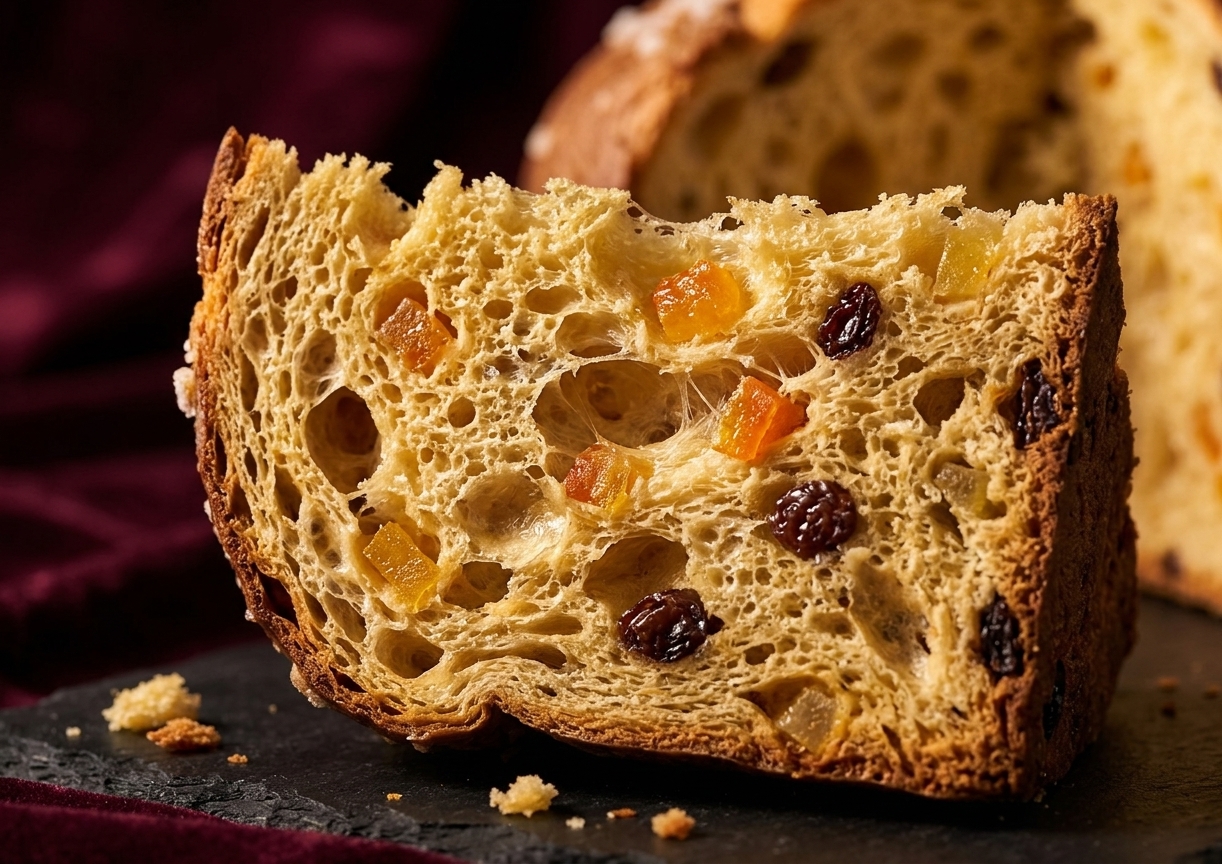
A slice of artisanal, naturally leavened " panettone " with a honeycomb texture and candied fruit
Origin as a hallmark: ingredients from Calabria
A gift of “ panettone ” also carries with it the story of the person giving it. In U Re Italo’s leavened baked goods, that story begins with Calabrian ingredients, many of which are protected by a European designation. The difference between the two designations is simple: for a DOP, all stages of production take place in the region of origin; for an IGP, at least one does.
Clementines from Calabria
The “Clementine di Calabria” PGI, established by EC Regulation 2325/97, is reserved for seedless fruits of varieties defined by the product specifications and grown in Calabria, a region that alone produces nearly half of Italy’s clementines. In pastry-making, it is the peel that matters most: thin and rich in essential oils, once candied, it retains a fragrance that anyone who grew up among the citrus groves of the Sibaritide region recognizes at the very first bite.
Calabrian Licorice (PDO)
Calabrian licorice has been registered as a PDO since 2011. Its production specifications indicate that it has a lower glycyrrhizin content than licorice grown elsewhere: its appeal lies in its aromatic complexity and a sweet flavor that lingers on the palate. In a leavened dough, it adds a deep, almost balsamic note that blends with the butter.
Cosenza PDO Figs
The “Fichi di Cosenza” PDO protects the dried fruits of the Dottato variety, grown in the province of Cosenza. Their tiny seeds give the flesh a full, meaty texture and a honey-like sweetness. Their reputation dates back centuries: as early as the beginning of the 19th century, the Statistica Murattiana recorded their export outside the Kingdom of Naples.
Moscato from the Saracena Estate, a Slow Food Presidium
Saracena’s Moscato al Governo is not a DOP: it is a Slow Food Presidium, a designation reserved for traditional products at risk of disappearing. It is made from native grape varieties such as Guarnaccia, Malvasia, Duraca, and Moscatello, and in the 16th century, barrels of it were shipped from the port of Scalea to the papal court. In the “ Panettone ” Italo, the raisins are allowed to rehydrate before being added to the mixture.
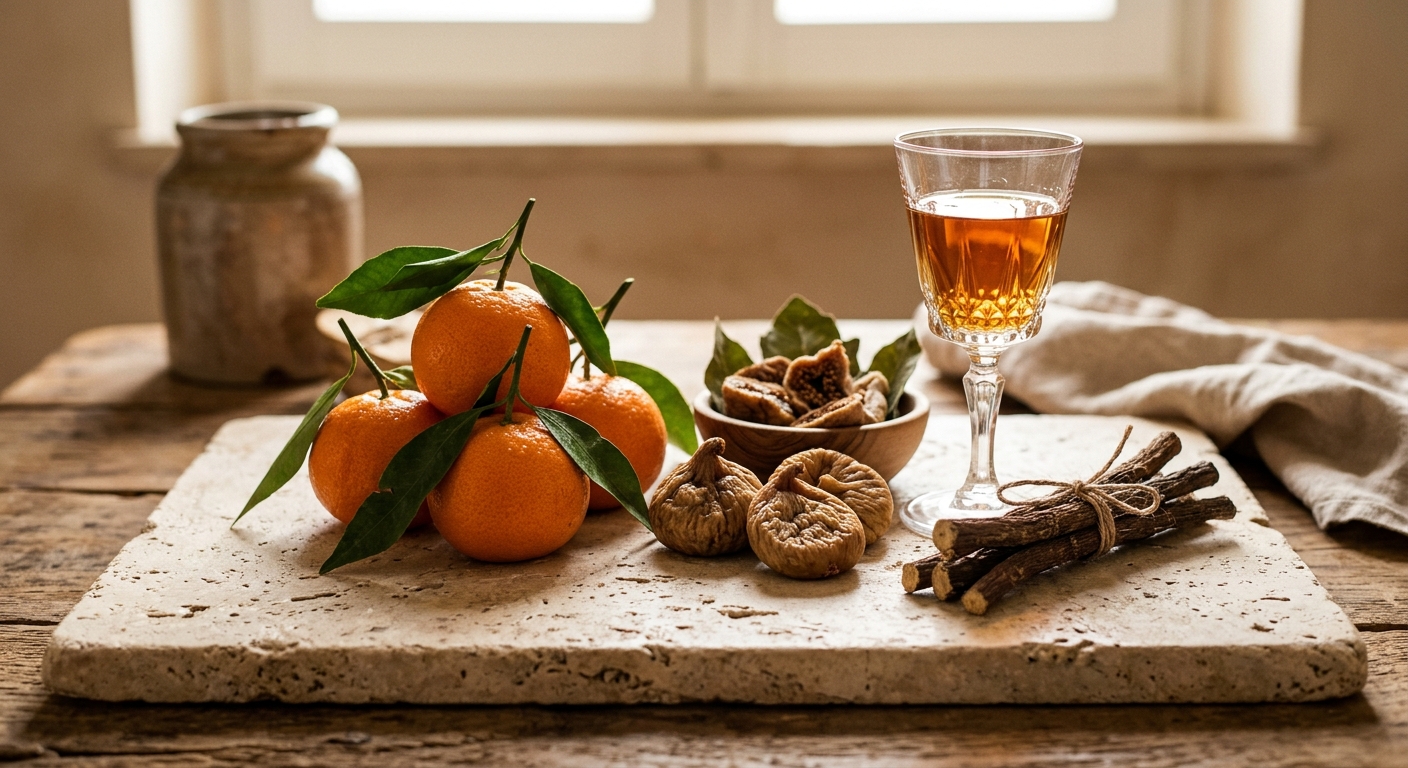
Calabrian PDO and PGI ingredients from the “ panettone U Re Italo”: clementines, licorice, Cosenza figs, and passito di Saracena
Who to Give It To
For those familiar with fine leavened pastries, the value of this gift lies in the story behind it: the origin of each ingredient, the time spent preparing it, and the limited production run. It’s a good idea to include a card with the “ panettone ” that lists the ingredients, because they are the part of the gift that lingers in the memory.
For those who live far from Calabria, a “ panettone ” made with figs, clementines, and licorice from their homeland feels like coming home. U Re Italo also ships to an address other than the orderer’s, so the gift reaches the recipient directly, both in Italy and throughout Europe.
For companies, the " panettone " is a way to present themselves to customers and employees with a product that conveys a distinct identity. For bulk orders and custom packaging, U Re Italo creates tailor-made solutions for corporate gifts.
When to Order It
A handcrafted “ panettone ” is made in small batches, and the production process cannot be rushed. U Re Italo’s production runs are limited and seasonal, and in recent years, their Christmas stock has sold out before the holidays. Anyone wishing to give it as a gift would be wise to order it well in advance, taking into account the shipping time to the final destination.
The gift is complete at the table
A handcrafted " panettone " is at its best when served at the right temperature. It's a good idea to include some serving suggestions with the gift for the recipient.
Storage. Keep it sealed in its bag in a cool, dry place, away from radiators and direct light. The refrigerator hardens the butter and dulls its aroma.
Before serving it. The day before, it’s best to leave it in a room at a temperature between 20 and 22 degrees, as suggested by the pastry chefs interviewed by Linkiesta. When it’s time to serve it, just place it in the oven for a few minutes after turning it off: the butter will melt, and the crumb will release all its flavors without drying out.
The cut. Thick, wedge-shaped slices, cut from the top toward the base, to reveal the honeycomb structure and the distribution of the fruit.
After opening, reseal the bag tightly by squeezing out the air, and consume within a few days.
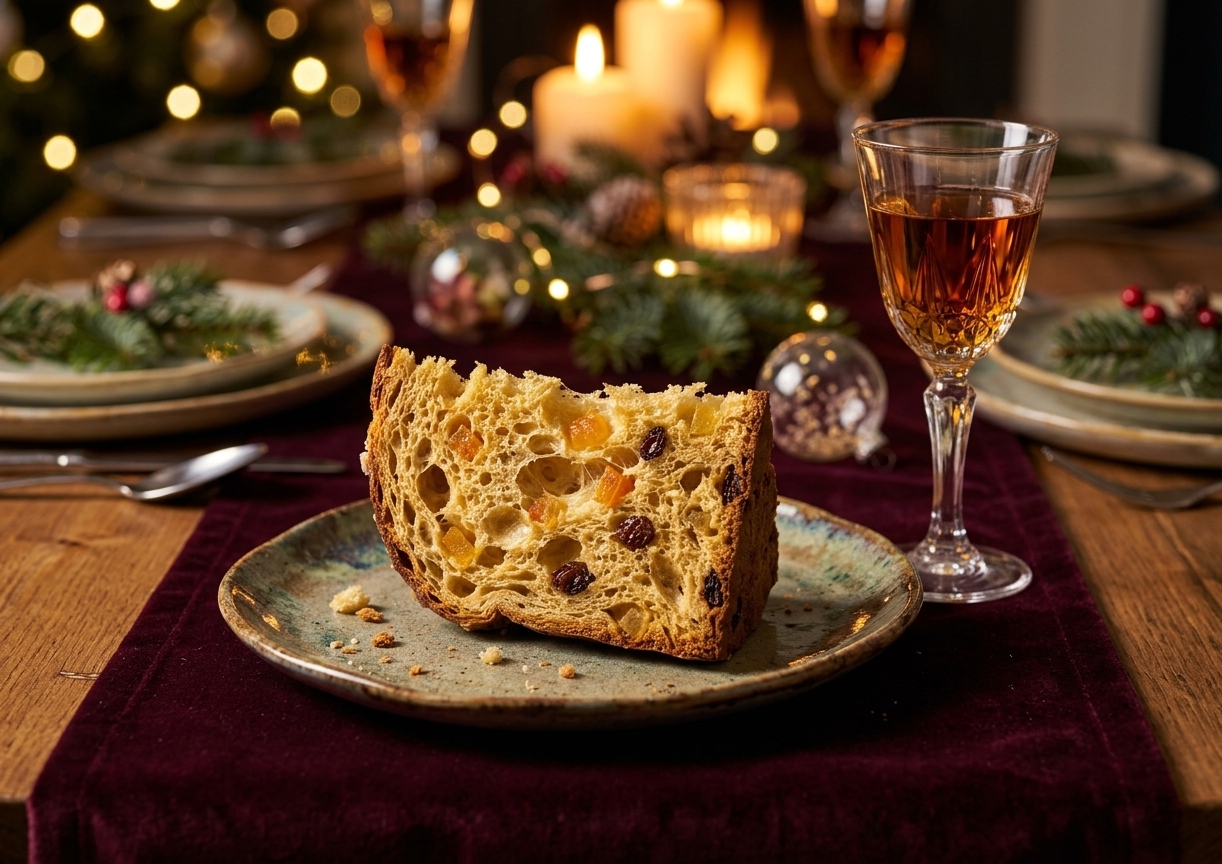
To pair with this dish, a Calabrian passito served chilled complements the fig and citrus notes in the dough.
A slice of “ panettone U Re Italo” served with a glass of Calabrian passito on the Christmas table
Italo
Best-selling
Italo is an artisanal yeast-leavened pastry made with organic candied orange peel from the Sibari Plain and dried raisins soaked in " Passito di Saracena." A Calabrian specialty with an intense aroma and an elegant flavor.
Wheat Flour · Butter · Water · Pasteurized Egg Yolks · Fresh sourdough starter · Natural wheat yeast (powder) · Dried raisins made from “Mazzarrone IGP Table Grapes” · Candied orange peel from the Sibari Plain · Organic orange paste · “Rocca Imperiale IGP Lemon” paste · Organic honey · Sugar · Salt
Preparation
A premium dough made with Type 0 flour and soft wheat sourdough starter, enriched with cream butter and pasteurized egg yolk for a velvety softness. Dried raisins made from “Mazzarrone IGP Table Grapes” combine with candied zest and organic orange paste from the Sibari Plain, creating a refined citrus aroma. The balanced sweetness of the sugar blends with notes of natural vanilla, while a touch of salt enhances every nuance. A masterpiece of tradition and carefully selected ingredients.
Stories from the Lab
The stories behind every flavor
From the Calabrian region to artisanal craftsmanship, from the secrets of natural yeast to the PDO ingredients that make our panettone unique in Italy: our blog shares what the packaging can’t convey. Read to understand, learn to make better choices.
How much does a handcrafted " panettone " cost, and what factors go into the price?
In 2025, the “ panettone ” from Milanese pastry shops reached an average price of 44.74 euros per kilo, compared to 8.58 euros for the industrial “ panettone ” ( Panettone Observatory by Maiora Solutions, via Il Giorno). The difference can be explained by three factors: the raw materials, which account for nearly half the price; the labor, which takes two or three days to make a sourdough “ panettone ”; and the packaging, which alone accounts for about one-fifth of the cost.
Why panettone uses candied fruit, and why not all candied fruit is the same
Today, candied fruit divides opinion. Some people seek it out, others avoid it, and still others consider it an unnecessary detail. Yet before becoming a controversial ingredient, candied fruit was a necessity, an achievement, a sign of civilization. Understanding why it is used means going back much further than a recipe; it means entering into a story of time, preservation, travel, and waiting.
How to Spot a Genuine panettone : 5 Tell-Tale Signs
In recent years, panettone become much more than just a Christmas dessert. It’s a topic of debate, a statement of style, a declaration of intent. Today, people talk about it all year round, comparing its rise, ingredients, and aromas, and even traveling to taste it. Yet, precisely because panettone become part of everyday conversation, recognizing a true panettone has never been more important.






 Created by Dopamine Studio